
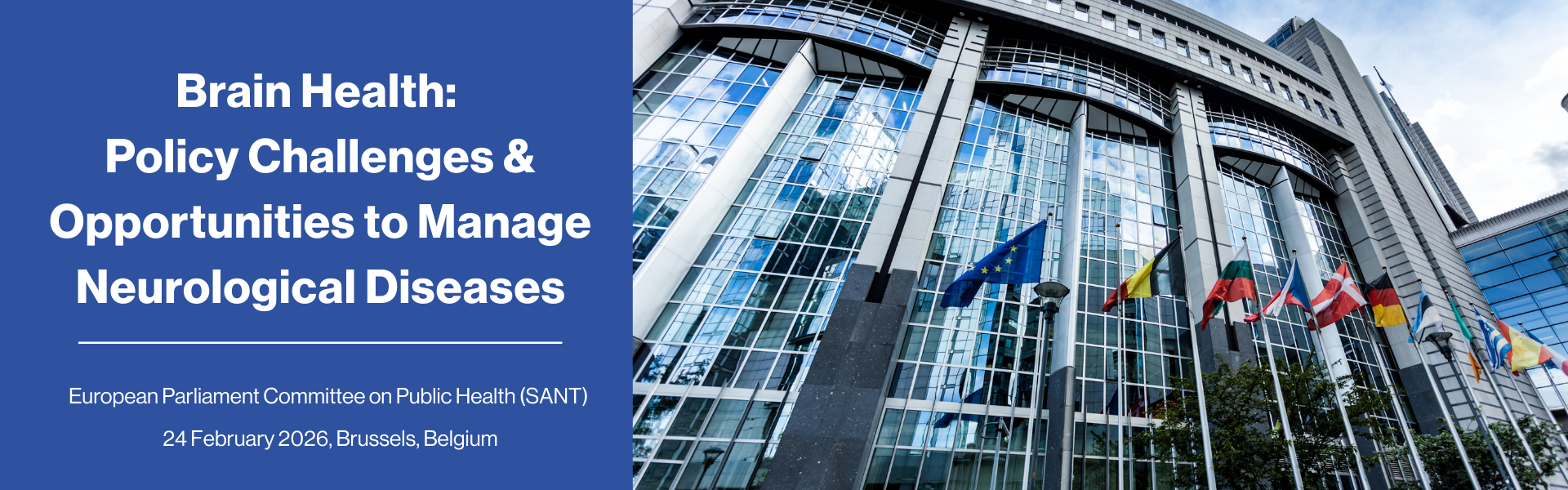
Brussels, 24 February 2026 – Today, the European Parliament Committee on Public Health (SANT) will hold a Public Hearing on ‘Brain health: Policy challenges and opportunities to manage neurological diseases’.
Brain disorders, neurological and mental alike, represent one of the most pressing health challenges facing the European Union. At least one in three Europeans currently lives with a brain condition [1], with such disorders now the leading cause of disability and second leading cause of death worldwide. In Europe alone, they impose an annual economic burden estimated to range between €800 [2] billion and €1.3 trillion [3], a figure set to rise as the population ages [4]. While recent strides have been made in improving the understanding of the brain, significant limiting factors remain – prompting the need for increased prioritization and coordination across the EU.
The European Brain Council (EBC), a network of key stakeholders in the brain space, has been invited to provide insight to the committee in a presentation and Q&A session, “European collaboration on neurological health, in particular in the field of dementia and other neurodegenerative diseases”, led by President-Elect, Professor Sameer Zuberi, and Board Member and Executive Director of the European Federation of Neurological Associations, Dr. Orla Galvin. Professors Ana Verdelho and Mirosław Zabek will also speak on Successes and challenges of cutting-edge research on neurology and the potential of neurotechnology.
Following the Exchange of Views on Neurological Health held by the SANT Committee in October 2024 [5], the growing attention from the European Parliament to brain health is welcomed by the community and demonstrates a reassuring and growing recognition of the urgency, timeliness and need to better tackle the staggering burden.
Furthermore, the emphasis placed on the need for increased coordination in the circulated briefing document [6] strongly echoes with the calls for an EU Coordination Plan for the Brain, work currently spearheaded by the European Brain Council. Actively involving its Member Organizations and partners, this Plan is dedicated to providing a cross-sectoral policy framework that aligns existing initiatives, reduces duplication, scales up best practices and maximises impact across the brain health continuum.
Despite the demonstrated burden of brain disorders as well as the central role of brain health in Europe’s resilience and competitiveness, policy responses remain fragmented across Member States. While 93% of EU Member States have mental health policies in place [7], only half of the WHO European Region has comprehensive neurological health policies as of 2017 [8].
The establishment of a European Coordination Plan for the Brain that aligns national and EU-level action around shared objectives, indicators and timelines is needed. Such a plan would reduce duplication of efforts, break down silos and maximise the impact of existing investments by adopting an integrated brain health approach spanning neurological and psychiatric disorders. The added value of increased EU action far outweighs the costs of inaction, which include escalating healthcare expenditure, lost productivity and avoidable disability.
Today’s SANT Committee hearing represents an important milestone in this process and, we hope, the beginning of a sustained and coordinated European approach that recognizes brain health as a strategic priority for the Union’s resilience, competitiveness and societal well-being.
Media Contact
Hugo Hermantin, Policy Coordinator. Contact.
Sources
- Economic Burden of Neurological diseases in Europe, European Academy of Neurology.
- J. Olesen et al., The economic cost of brain disorders in Europe, European Journal of Neurology 2012, 19: 155–162.
- Economic Burden of Neurological diseases in Europe, European Academy of Neurology.
- The Hidden Depths of Neurological Disease, Politico.
- EBC Invited to Address the European Parliament Public Health Committee, European Brain Council.
- Strengthening Brain Health: Policy Recommendations to Tackle the Rising Burden of Neurological Diseases, Briefing Document Requested by the SANT Committee, PE 780.418 – February 2026.
- Mental health systems capacity in European Union Member States, Iceland and Norway. Copenhagen: WHO Regional Office for Europe; 2024, p.3.
- Atlas: country resources for neurological disorders – 2nd ed. Geneva: World Health Organization; 2017. p.19.