Neurotechnology touches some of the most intimate dimensions of being human – cognition, behaviour, mental health, autonomy, identity. From brain implants restoring movement to consumer devices marketed for sleep and focus, it is reshaping healthcare and raising profound ethical questions at the same time.
Europe is already the world’s second-largest neurotechnology market. But despite its scientific strength and strategic relevance, the field remains largely absent from the EU’s political agenda – leaving innovators, patients and consumers exposed to regulatory uncertainty, while the United States and China move with growing ambition.
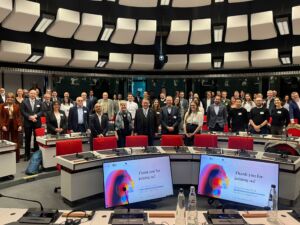
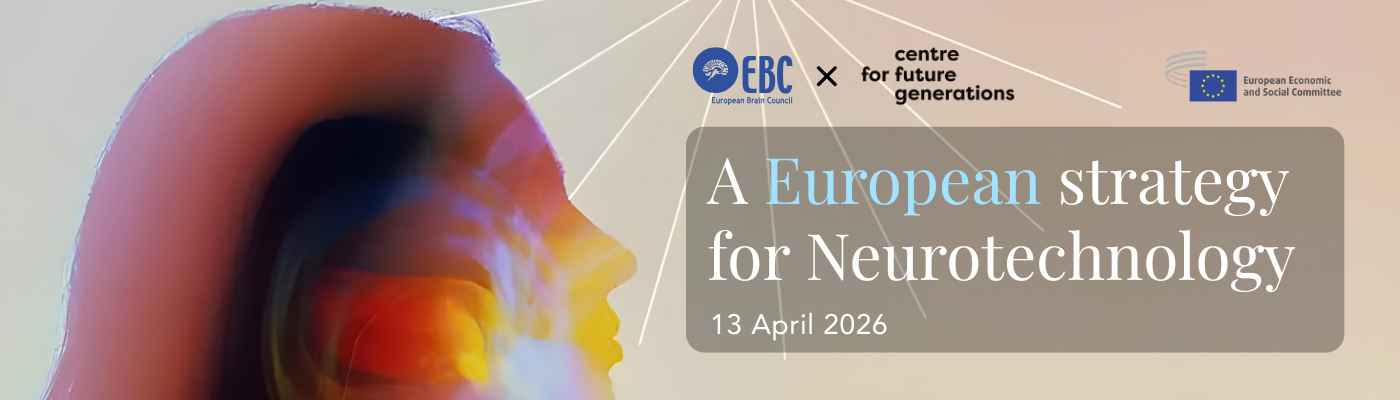
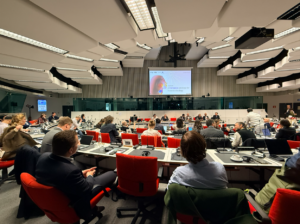
Hosted by the European Economic and Social Committee on 13 April 2026, the event “A European Strategy for Neurotechnology” brought together policymakers, researchers, clinicians and civil society to ask: How does Europe turn its existing momentum into a coherent strategy? One that strengthens competitiveness, closes governance gaps and ensures neurotechnology develops in line with European values.

Opening Remarks
Virginia Mahieu (Neurotechnology Director, Centre for Future Generations (CFG)) and Frédéric Destrebecq (Executive Director, European Brain Council (EBC)) opened the event by welcoming the collaboration between CFG and EBC. Maurizio Mensi (Member, European Economic and Social Committee) welcomed attendees to the EESC – the ideal forum for civil society voice in this debate – and situated Europe’s position as the world’s second neurotechnology market. Strong, but not guaranteed.
Mensi highlighted the dual-use nature of neurotechnology – spanning medical and non-medical applications – and pointed to two critical gaps in the current EU framework: the ambiguous legal status of brain data under the GDPR, and the regulatory grey zone between wellness and medicine. Closing these gaps, he argued, is not anti-innovation:
“The risk is twofold. First, Europe could fail to capitalise upon an area where it has real strength; and second, it could leave patients, consumers and innovators exposed to legal uncertainty and uneven protection. A European strategy would allow us to direct innovation towards unmet medical and societal needs, and embed ethics, fundamental rights and the public interest into design, deployment and oversight from the outset – not as an afterthought. If we succeed, Europe can show that leadership in new technology is not a race to the bottom on standards, but a race to the top. Combining excellence in science and industry with excellence in rights, ethics and democratic oversight – that is the European way. And it can be our advantage.”
Neurotechnology State-of-Play
The CFG Neurotechnology Team presented the state-of-the-art in neurotechnology and reviewed recent developments, highlighting three key research outputs: the Neurotech Market Atlas, the Neurotech Governance Map, and Wired for the Future.
Pawel Swieboda (Senior Fellow – Neurotechnology, CFG) drew on CFG’s ‘Wired for the Future’ report to make the case that neurotechnology is not optional infrastructure – it is essential for brain health. Approximately 165 million Europeans live with a brain condition; where circuits are broken, pharmacological approaches often cannot repair them, but neurotechnology increasingly can. He highlighted recent milestones including CorTec’s FDA Breakthrough Device Designation for its BCI system for stroke rehabilitation, and called for faster clinical trials, dedicated manufacturing platforms and greater investment in non-invasive devices:
“Neurotechnology is not a good-to-have. It’s a must-have in brain health. And this is because the brain functions as a network of adaptive circuits. And if circuits are broken, you need to try to repair them. This is what neurotechnology increasingly offers us a chance of doing.”
Europe has produced pioneering work in this field and must now invest strategically to maintain that edge.
Virginia Mahieu (Neurotechnology Director, CFG) based her presentation on CFG’s Neurotech Market Atlas – an analysis of nearly 300 dedicated neurotechnology companies worldwide. Consumer firms now represent approximately 60% of the global neurotechnology landscape, driven by miniaturisation, AI and integration into mainstream wearables. They reach market faster and generate comparable revenue with a fraction of the funding:
“Consumer companies have more than tripled in the last decade and actually represent 60% of all neurotechnology companies now. Consumer neurotechnology is cheaper to produce and has fewer regulatory steps to go through, so it reaches the market faster than medical neurotechnology.”
This creates a commercial pull that risks drawing investment away from medical innovation. And as consumer technologies become more powerful, the boundary between wellness and medicine blurs – a crucial question for legal frameworks that remains unresolved. The disclosure gap is striking:
“Half of the companies we analysed did not disclose that their products were not medically certified in their terms and conditions. This could lead to users delaying seeking proper medical treatment, and it could damage trust in the sector as a whole.”
Mehmet Onur Cevik (Project Lead – Tech Policy and Enforcement, CFG) presented CFG’s Neurotech Governance Map – covering 22 EU regulatory frameworks, international instruments and national examples. The EU toolkit is extensive and valuable, but it was not designed with neurotechnology in mind. As consumer devices proliferate beyond medical device regulation, the range of relevant legislation broadens while coordination between frameworks remains weak:
“The existing EU toolkit is very rich. But although these laws are great instruments for governance, they were not designed specifically for neurotechnology. So there are gaps… The regulatory scene is as fragmented as it is diverse. If neurotechnology becomes integrated into mainstream digital platforms – products that we already use every day, for instance AirPods – its reach could scale very, very quickly.”
The European Charter for the Responsible Development of Neurotechnologies
Sameer Zuberi (President-Elect, European Brain Council) introduced the European Charter for the Responsible Development of Neurotechnologies – taking stock of its milestones and launching a new initiative: the Seal of Trust for Responsible Neurotechnologies.
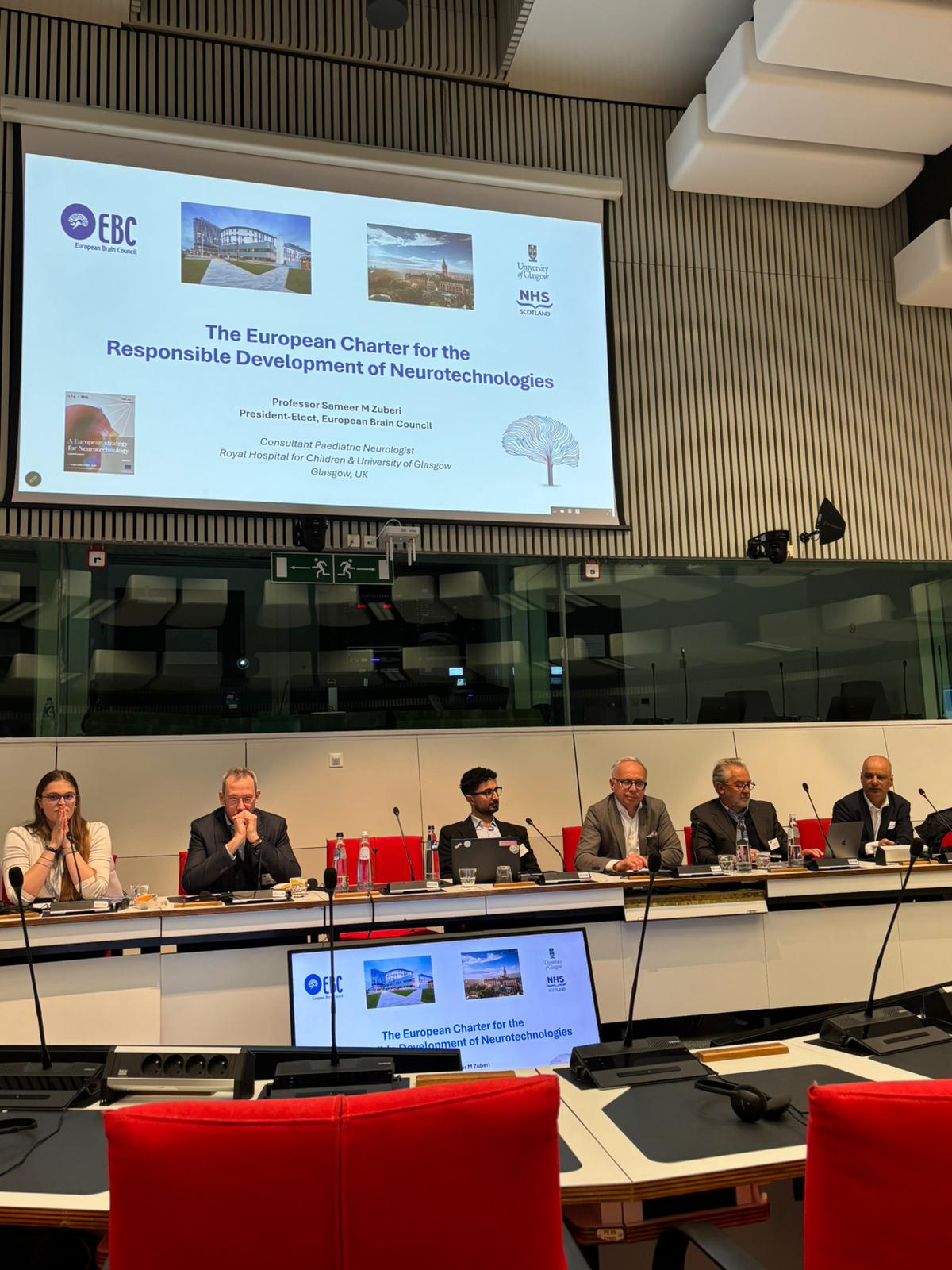
Applying to both medical and non-medical devices, the Charter was developed through a multi-stakeholder process building on the 2019 OECD Recommendation on Responsible Innovation in Neurotechnology, aligning with the 2025 UNESCO Recommendation on the Ethics of Neurotechnology, and grounded in the 2023 León Declaration on European Neurotechnology. Its core aim is not to restrict neurotechnological development, but to support it responsibly – translating shared values into practical guidance for companies, policymakers and investors alike.
“One of my patients was the youngest ever child to have a deep brain stimulator in the world, two years of age. That produced great benefit, but it also produced some complications for that child. Neurotechnology really provides us a very exciting hope for improved health, but with any new development comes uncertainty and risk we need to understand, communicate, disseminate. We have very clear regulation of medical devices but there is increasing anxiety about the ethical issues around non-medical applications, so this charter is going to cover both areas.”
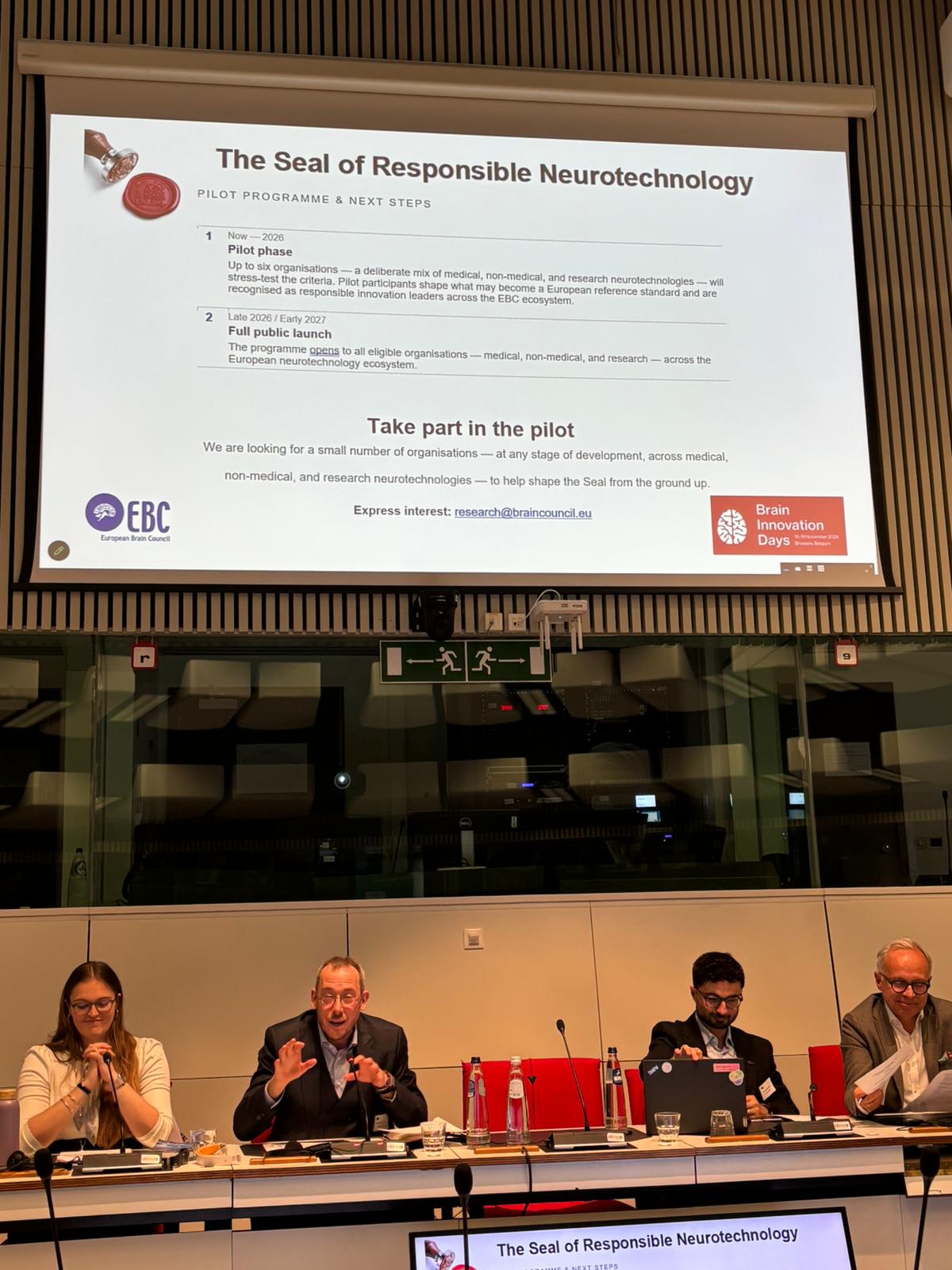
Adopted in April 2025, the Charter is now entering a broader dissemination and implementation phase, with a planned publication in Nature Human Behaviour. The Seal of Trust for Neurotechnologies is being developed as a practical tool to help organisations demonstrate alignment with Charter principles in a verifiable way. A pilot is currently underway: stakeholders are invited to get involved and join the Brain Innovation Days to see early results.
“We are working on a seal of excellence to incentivise industry adoption and political support, so to turn this charter into real action. If we have a charter, and then a framework for a seal around this charter, then hopefully it can promote the development of neurotechnology in a responsible way, practically.”
Fireside Chat: The Power of Soft Laws
From international recommendations and ethical guidelines to standards and charters, non-binding instruments increasingly shape how technologies are developed and governed across borders. How does soft law complement regulation, align diverse actors and help embed responsibility and trust within Europe’s evolving neurotechnology ecosystem?
Pascal Maigné (Expert, French Biomedicine Agency), Dafna Feinholz (Director a.i., Division of Research, Ethics and Inclusion, UNESCO) and Hervé Chneiweiss (Chair, EBRAINS Ethics and Society Committee) moderated by Frédéric Destrebecq (EBC) explored the distinctive role of soft law in neurotechnology governance.
Soft law’s distinctive strength is its ability to evolve quickly – both in design and implementation – at a pace that hard law cannot match. It can raise warnings, anticipate questions and build consensus without the administrative delays of the legislative process. The speakers agreed that soft and hard law are not in tension: they are complementary.
“A Charter has a bottom-up approach where a large representation of stakeholders agrees upon a set of shared values and uses those values to elaborate guidelines and principles to be respected in the development of neurotechnologies: this inclusive process will enforce its legitimacy. There is a need for mechanisms which are rapid and agile enough to take public opinion into account”, Pascal Maigné (French Biomedicine Agency)
“Governance is multilayered: it is not a one-shot process but something that needs to be continuously adapted and to include different actors at different stages. Responsible development must also include what happens if the device fails or if the company fails – we need to have a holistic view of the process”, Hervé Chneiweiss (EBRAINS)
“It is very important to engage the community and the users, including different actors and civil society: everything about our intimacy and identity are changing with these technologies”, Dafna Feinholz (UNESCO)
UNESCO’s Recommendation on the Ethics of Neurotechnology was developed through expert consultation representing over 110 countries, covering education, labour, children, the elderly and people with disabilities. More than 70 countries are now engaged in UNESCO’s neurotechnology readiness assessment.
Further governance considerations raised included the impact of neurotechnology on developing brains, the need for inclusive design, the interplay between the GDPR and the AI Act – which Hervé Chneiweiss noted may be more significant for neurotech governance than the GDPR. Responsible development requires a holistic view of the full technology lifecycle.
Launch of CFG White Paper on an EU Neurotechnology Strategy
Virginia Mahieu (CFG) presented the three pillars of CFG’s White Paper ‘Towards an EU Neurotechnology Strategy’, translating the event’s momentum into a concrete policy agenda. The goal, she emphasised, is not to reinvent the wheel:
“The goal is to think about the responsibility of the European Union as a stakeholder in this ecosystem: What is it up to the EU now to do and to act, based on the different initiatives, frameworks and recommendations that we have? Clearly there is a growing consensus from the charter, UNESCO, OECD around the principles that should guide neurotechnology; but neurotechnology is becoming a strategic domain at the intersection of health, AI and other areas, and other regions of the world are already starting to move more decisively when it comes to policy and legislation. The challenge for the European Union at this moment is to translate this momentum into a strategic economic, political and legislative approach.”
The three pillars of the White Paper reflect the three things the EU can most directly act on:
- Pillar 1: Funding Ethical Innovation. Neurotechnology falls between broad and undifferentiated EU funding streams. The White Paper recommends a Neurotechnology Funding Board to navigate and adapt existing instruments, support innovation hubs and pool reimbursement schemes across Member States – enabling companies to scale across the single market.
- Pillar 2: Regulatory Cohesion. The EU’s regulatory arsenal is fragmented and indirect. The White Paper recommends leveraging the Digital Omnibus to recognise brain data as sensitive data under the GDPR and calls for regulatory cohesion between medical and consumer device frameworks, regulatory sandboxes and improved early-dialogue pathways with regulators.
- Pillar 3: Public Engagement. Neurotechnology interacts with the most intimate aspects of human life. The White Paper calls for proactive lifecycle engagement with users and civil society, investment in interdisciplinary skills and common terminology, and a central role for soft law instruments including the EBC Charter.
This presentation opened the floor to a series of three roundtable discussions addressing challenges and opportunities across the EU neurotechnology ecosystem.
Roundtable Discussion: Optimising the Innovation Ecosystem for Responsible Neurotechnology Development
How can Europe strengthen its neurotechnology innovation ecosystem while embedding responsibility from the outset? What funding instruments, scaling pathways, public– private partnerships and research infrastructures are needed to support sustainable growth and global competitiveness?
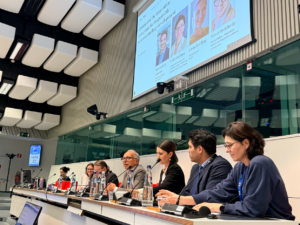
Federica Zanca (EIC Programme Manager for Medical Technologies and AI in Healthcare, EISMEA) presented the EIC’s approach to breakthrough innovation in neurotechnology. The EIC funds projects through Pathfinder, Transition and Accelerator instruments – the latter providing up to €10M per company in grants plus equity. Neurotechnology represents 14% of the EIC’s portfolio – the largest share of any disease area – with all funded projects leveraging AI. A notable innovation is the portfolio model: a €37M challenge was allocated across nine projects required to collaborate and build shared assets beyond individual science.
“We are really working very strongly with investors and we acknowledge investors are generalists – they don’t understand that healthcare is not energy: they should not expect a return on investment in five to seven years. At least 10 to 15: clinical trials are very long.”
The EIC is also working with the Commission to pilot new regulatory approaches for neurotech medical devices – including a non-profit institute to guide companies from concept to CE mark. A structural challenge remains: companies currently favour the FDA pathway for its clearer contact points, and the EU must improve how it communicates its regulatory landscape.
Mark Vlek de Coningh (Secretary General, NeurotechEU) presented NeurotechEU’s work to build Europe’s first interdisciplinary Master’s programme in neurotechnology, launching in 2028. The consortium brings together universities from across Member States, combining neuroscience, engineering, AI, medicine and policy. The challenge is institutional as much as educational:
“Now is the most important time to create an ecosystem in Europe. I think we run into many of the same problems that companies, startups and investors run, which is huge institutional barriers between the different Member States.”
Laura Kreiling (Policy Analyst, OECD) noted that a formal 2024 reporting process on the OECD’s 2019 Recommendations on Responsible Innovation in Neurotechnology found that implementation was proceeding primarily through policies rather than new laws, and that neurotech policy discussions have been consistently overshadowed by AI. Experience in the AI field shows that embedding high-level principles into practical toolkits and sandboxes is what actually drives implementation. The same model could work for neurotechnology. But translation remains Europe’s weak point:
“The newer technology conversations have been a bit overshadowed by the discussions on AI. The recommendation on AI has already been revised and there are now toolkits and more and more guidance being developed by the OECD itself, but also by partners and by member states. When it comes to keeping companies in Europe we need to work harder.”
Roundtable Discussion: Creating a Clear and Cohesive Regulatory Framework
Where do current EU regulatory frameworks fall short in addressing neurotechnology, particularly at the intersection of data protection, AI governance, medical devices and consumer protection? How can existing and forthcoming policy instruments be better aligned to provide legal clarity, safeguard fundamental rights and support innovation?
Vassilis Tzevelekos (Member, UN Human Rights Council Advisory Committee) presented the Committee’s ongoing work to draft guidelines on how existing international human rights law should apply to neurotechnology. Neurotechnology is fundamentally different from other technologies: it provides direct access to, and potential interference with, the human brain – touching freedom of thought, mental integrity, the right to privacy and the right to health.
“The right to health is not only a right that is affected by neurotechnology, but also a right that can be protected through neurotechnology: if there is a risk to human rights, states must prevent it; but if rights can be enhanced through neurotechnology, states must also be in a position to provide it. We identified several social groups that are particularly affected, including persons with disabilities, children, older persons and individuals in situations of power imbalance, including workers, detainees and individuals in military or security domains. These populations have higher risks of coercive or non-consensual use of neurotechnology. The advisory committee has called for the application of the precautionary principle: priority should be given to medical uses because we are not yet in a position to properly assess what the impact on human rights would be.”
Elisabeth Steindl (Senior Researcher, Ludwig Boltzmann Institute Digital Health and Patient Safety) argued that the key legal gap in the GDPR is not about neurotechnology specifically – it is about inferences about the mind. Emotions, thoughts and intentions inferred by any technology, not just neurotech, leave individuals vulnerable to manipulation and fundamental rights violations. A technology-neutral, comprehensive approach to protecting such inferred data is needed:
“Why should your emotions be granted higher protection because they are processed through neurotechnology, but the very same emotion is not worth protecting if it is processed through a text-based technology? We need a much broader and more comprehensive approach.”
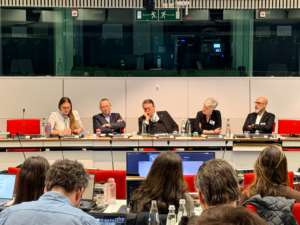
Ricardo Chavarriaga (Leader, Responsible AI Innovation, ZHAW Centre for Artificial Intelligence) noted that the regulatory landscape for neurotechnology is still being written – and is already too complex for most founders to navigate. The AI Act’s risk-based approach offers a useful model, but what will determine its actual impact is the process of translating written rules into operational standards. Governance must avoid creating parallel tracks that compound the burden on innovators:
“If we look at some of the existing instruments for governance that relate to neurotechnologies, the first thing that we realise is there are too many; and if it seems complex for legal scholars, imagine what it looks like for the founder that has never during their formative years heard the term regulatory roadmap. We should be aware of what are the existing mechanisms that already address these issues, instead of creating parallel tracks of governance that only feed into the confusion – the perceived or real regulatory burden that innovators have.”
Roundtable Discussion: Fostering Public Awareness and Inclusive Stakeholder Engagement Throughout the Neurotech Life Cycle
How can public understanding of neurotechnology be strengthened, and whose voices are currently missing from policy and innovation discussions? What mechanisms can ensure meaningful, inclusive stakeholder engagement throughout the neurotechnology life cycle – from research and development to deployment and post-market oversight?
Orla Galvin (Board Member, EBC; Executive Director, European Federation of Neurological Associations (EFNA)) emphasised the importance of patient and clinical communities at every stage of neurotechnology development and governance. EFNA participates in patient and consumer working parties and HTA (i.e., Health Technology Assessment) working groups within the European Medicines Agency, bringing neurological patient communities into regulatory processes. Neurological conditions span the full population – from children to the elderly – and neurotechnology frameworks must be understood as tools for good. Sustained education and awareness-raising across all stakeholders, drawing lessons from other sectors’ experience with AI and digital health, is a foundational step.
“When it comes to stakeholder engagement, please do not think that you can dismiss or neglect patient insights: we often see a more strategic approach and an expedition of development when the patient community is included. Neurotechnology is not all about the head – it’s from your head to your toe. The neurotech charter and policy frameworks are assets for good, provided everyone at the table is aware of them and knows how to use them. Education of all stakeholders – even just awareness – will make a massive step, for people living with neurological conditions but for society as a whole.”
Alice Accorroni (Co-Chair, AI in Clinical Neurology Task Force, European Academy of Neurology) argued that patients and clinicians too often engage only as end users rather than co-designers. Early and structured engagement – from research through post-market surveillance – ensures tools are clinically useful, equitable and trusted. Cross-country and cross-system engagement are essential to account for diversity in clinical settings and patient populations. Domain-specific guidance for neurology, psychiatry and neurosurgery is required, both within and beyond clinical practice. Patient populations are heterogeneous, therefore information must be adapted accordingly with patient representatives and clinicians at the table throughout development. When this happens, neurotechnology generates real-world evidence that meaningfully informs policymakers.
“Patients and clinicians are engaged in the development of new technologies as end users – at the end of the development. It would actually be very important to have clinicians involved at the very beginning, in the design of these new technologies. When clinicians and patients are involved in multi-stakeholder engagement, we obtain amazing technologies that are able to revolutionise the way we do clinical practice. What is ‘good’ is quite relative to culture – and this is why it is important to have all the different complementary expertise and vision, so that we ensure that we go along together with society.”

Jim Dratwa (Policy Lead, Science for Policy, European Commission) raised fundamental questions about how citizens engage with decisions that will shape the future of the brain-tech interface. Society should not be determined by a few actors – all citizens have a stake. Governance must avoid a false choice between regulation and funding: both are needed and should reinforce each other. Drawing lessons from the AI regulatory experience, he argued for agile, adaptive governance that acknowledges the shortcomings of pioneering frameworks like the GDPR and the AI Act, without abandoning them. No dedicated ‘Neurotech Act’ is needed: what is needed is to broaden the diversity of stakeholders involved, build on existing foundations and foster genuine deliberation about the common good.
“Let’s avoid the trap of thinking that regulation is the problem and that less regulation is the solution. We shouldn’t fall into the trap of choosing between regulation and investment – we should be combining both. And we shouldn’t fall into perhaps the worst trap of all: the notion that it’s always too early – ‘What is there to regulate?’ – or too late – ‘The toothpaste is out of the tube.’ Maybe we’re having this conversation at the right time. Neurotechnology for good – but this is not the answer. It is the start of the question: what do we mean by the good, and how can we get together to deliberate on that?”
Wrap-up and Closing Remarks
Paul Rübig (Member, European Economic and Social Committee) closed with reflections on a day of rich dialogue spanning risk-based governance, lifetime assessment of neurotechnology and the societal implications of brain-computer interaction. He highlighted the knowledge economy dimension: if knowledge brings revenues, how can the benefits flow back to those who create it? He drew a contrast with China’s state-centric approach to data ownership and underlined the importance of Europe’s values-based alternative.
“We have a lot of excellent silos – not only at the European level but globally –a lot of great thinkers who can really seize the challenges. But the truth is a silo-and-pipe strategy: how can we distribute the knowledge through the pipes? Knowledge as a public good is a very important strategy. But on the other hand, if knowledge brings revenues, how can we get the benefit back to the one who created it?”
Virginia Mahieu (CFG) thanked the European Brain Council for the collaboration, her team and all speakers for sharing their time and expertise, and participants for contributing to such a vivid and substantive exchange. She expressed hope that the CFG White Paper can help translate the momentum of the day into concrete policy action for a European Neurotechnology Strategy.