

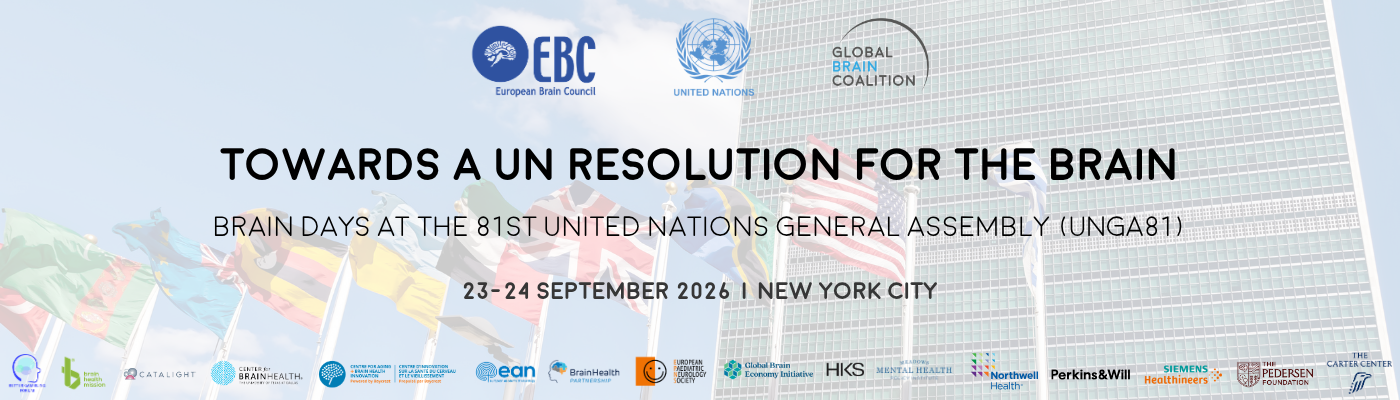
2026 Brain Days Programme – UNGA81
The Brain Days at UNGA81 will again serve as a platform to bring together policymakers, scientists, innovators, patient advocates, funders and international organisations to help advance a shared global agenda. Brain Days will take place on 23rd & 24th of September, 2026, at Cure. in New York City. Structured around two interconnected pillars, this year’s event will explore global collaboration in brain health research and innovation — including funding, science diplomacy and international partnerships — and the broader societal and policy dimensions of brain health, including brain capital, prevention, resilience and pathways towards greater recognition at United Nations level. Building on discussions initiated in previous editions while looking firmly ahead, the event will aim not only to showcase progress, but to create a space for active discussion and catalyse concrete next steps for collective action.
Day 1: 23 September
Morning: Strengthening Research & Innovation and Global Science Collaboration
- Suzanne Dickson, President, European Brain Council
- Frédéric Destrebecq, Executive Director, European Brain Council
- Andy Keller, President, Chief Executive Officer, and Linda Perryman Evans Presidential Chair, Meadows Mental Health Policy Institute
The community attending the Brain Days are what make it unique and special, and every year the perspectives we hear from the audience bring another layer of expertise to the wider brain-related community, may it be the ‘usual actors’ such as researchers, clinicians, patients and scientific organizations or the ‘unsuspecting allies’, such as architects, investors, start-ups, and key opinion leaders interested and active in the space. This year’s event aims to be as interactive as possible, learning and growing from the audience to build towards stronger policy and prioritization of the space.
Speakers will be announced closer to the event.
- H.E. Ambassador Luís Gallegos, United Nations Institute for Training and Research (UNITAR); Former Minister of Foreign Affairs of Ecuador
- Silvia Bojinova, Team Leader – Inter-institutional and Multilateral relations, International Cooperation – Europe and Americas Unit, Directorate-General for Research and Innovation, European Commission
- Catherine Marquer, Agence Nationale de la Recherche, France
- Louise Parr-Brownlie, Brain Health Partnership Co-Lead for New Zealand; University of Otago
- Patricia Conrod, Canadian Institute for Health Research, Canada
- Moderated by: Frédéric Destrebecq, Executive Director, European Brain Council
This panel discussion will use the recently launched European Partnership for Brain Health as a leading example for growing interest in global collaboration for science, examining its ambition to position Europe as a uniting force for stronger global collaboration in brain research and innovation. Currently the largest multi-country, co-funded collaborative efforts in brain research worldwide, it brings together international leaders from science, policy, and funding communities. The session will explore how the Partnership seeks to strengthen science diplomacy, foster coordinated action across borders, and build long-term collaboration on shared brain health challenges. Speakers will discuss the importance of connecting partners across regions and disciplines to break down silos, align research priorities, encourage knowledge and data sharing, and accelerate scientific progress.
Following the panel discussion, participants will be invited to join an interactive exchange focused on the role and impact of global collaboration in brain health and research. This session will provide an opportunity for audience members to share their experiences, perspectives, and challenges related to international cooperation, cross-sector partnerships, and collaborative research initiatives. Through open discussion and audience feedback, the session will explore how global collaboration has influenced participants’ work, where barriers and gaps remain, and what actions are needed to strengthen connectivity, break silos, and foster more effective collaboration across regions and disciplines in the future.
11:00 – 11:20 | Coffee Break
- Allison B Sekuler, PhD, FCAHS, FSEP, FAPS, FPsyS, Sandra A Rotman Chair in Cognitive Neuroscience, Rotman Research Institute and University of Toronto; President & Chief Scientist, Centre for Aging + Brain Health Innovation and Baycrest Academy for Research and Education
- Arthur Evans, Chief Executive Officer and Executive Vice President, American Psychological Association
- Zia Agha, Chief Medical Officer, West Health Institute
- Laura Murray, Senior Scientist, Johns Hopkins Bloomberg School of Public Health
- Josh Hsu, General Counsel, Slingshot AI
- Moderated by: Hannah Wesolowski, Chief Advocacy Officer, National Alliance on Mental Illness
Artificial intelligence is rapidly reshaping how we both protect and improve brain health. From improving early diagnosis to enabling more personalized therapeutics for mental health care, AI has the potential to become a powerful accelerator for brain health worldwide. At the same time, realizing these benefits while protecting vulnerable populations will require thoughtful policies that foster both innovation and safety. This session will explore how cross-sector collaboration can harness AI to improve brain health, with a particular focus on mental health and the policy strategies necessary to ensure that these technologies are safely and effectively employed.
In collaboration with the Meadows Mental Health Policy Institute
- Michael Platt, Director, Wharton Neuroscience Initiative and Penn Integrates Knowledge; Professor of Marketing, Neuroscience, and Psychology, The University of Pennsylvania
- Moderated by: Tim Foxx, Director, Center for School Study Councils, The University of Pennsylvania
- Shawn Fluharty, West Virginia State Delegat
- Paul Pellizzari, Vice President, Global Social Responsibility, Hard Rock International and Seminole Gaming
- John McKeon, New Jersey State Senator
- Devdutta Sangvai, Secretary, North Carolina Department of Health and Human Services
- Erin Keating, Superintendent, Scranton School District
- Moderated by: Toby Ewing, The Kennedy Forum
13:00 – 13:40 | Lunch Break
Afternoon: A Life Course Approach – Future Generations, Future Health
- Ming Lim, Board Member, European Paediatric Neurology Society (EPNS); Chair, EPNS Advocacy & Collaboration Committee
- Liron Sinvani, Director of Research & Innovation for the Institute for Healthy Aging, Northwell Health
- Moderated by: Sameer Zuberi, President Elect, European Brain Council
Protecting brain health requires action across the entire lifespan. In this fireside chat, experts in childhood neurology and geriatrics will discuss why a life course approach is essential for understanding, promoting, and preserving brain health—from early brain development through healthy ageing. By examining the links between neurological health in childhood, adulthood, and later life, the conversation will explore how research, prevention, and care strategies can be better aligned to reduce the burden of brain disorders and support brain health for all.
- Arabela Acălinei, Vice President, European Federation of Neurological Associations (EFNA)
- Celso Arango, President-Elect, European Psychiatric Association (EPA)
- Paul Boon, Co-Chair, Brain Health Mission (BHM)
- Joanna Lai, Health Specialist, UNICEF
- Moderated by Kailash Bhatia, President, European Academy of Neurology (EAN)
Despite brain disorders being the leading cause of disability worldwide, public awareness of brain health remains fragmented, disease-specific, and often disconnected from prevention and policy action. This discussion will explore how professional societies, patient organizations, mental health stakeholders, and international partnerships can work together to build a recognizable and actionable global brain health movement.
In collaboration with the European Academy of Neurology and the Brain Health Mission.
- Jafri Malin Abdullah FASC, Fellow, Council Member and Advisor of Special Interest Group on Brain Economy for Malaysia, Academy of Sciences Malaysia
- Facundo Manes, Neurologist and Neuroscientist, Institute of Cognitive Neurology (INECO); National Deputy, Argentina
- Elizabeth Allen, Executive Advisor – Strategic Policy and Programs, Canadian Centre on Substance Use and Addiction
- Sheryl Batchelor, Founder and CEO, Yiliyapinya, Australia
- Moderated by: Amy K. Dittmar, Provost, Rice University
This panel discussion brings together pioneering leaders from around the world who are championing brain capital and elevating the brain economy to the forefront of national policy agendas in their home countries. Representing diverse sectors including government, business, healthcare, science, education, and innovation, the speakers will share how they are advancing policies and initiatives that prioritize brain health, cognitive skills, mental wellbeing, and human potential as essential drivers of economic growth and societal resilience.
Beyond showcasing success stories, this conversation aims to inspire other countries and stakeholders to consider how brain capital can become a strategic national priority. The discussion will also create an opportunity for mutual learning among the speakers themselves, as they exchange experiences, challenges, and lessons learned from their respective national contexts. Participants will hear firsthand how the concept of the brain economy is being received, adopted, and integrated by governments around the world — and where important gaps and opportunities remain.
15:20 – 15:40 | Coffee Break
- Babatunde Omilola, Head of Division, Human Development – Agriculture, Human and Social Development Complex, African Development Bank Group
- Valérie Boulet, Chief Development Officer, WHO Foundation
- Javier Guzmán, Division Chief for Health, Nutrition and Population, Inter-American Development Bank
- Sylvie Raver, Managing Director, Science Philanthropy Accelerator for Research and Collaboration (SPARC) team, Milken Institute Strategic Philanthropy
- Moderated by: Frédéric Destrebecq, Executive Director, European Brain Council
As economies around the world confront demographic change, technological disruption, and rising mental health and neurological challenges, a new economic paradigm is emerging: the brain economy. Recognizing brain health, cognitive skills, mental wellbeing, and human capital as critical drivers of productivity, innovation, and sustainable growth, governments, investors, and development institutions are increasingly exploring how to finance a brain-healthy transition. This panel brings together leaders from international organizations, regional development banks, and development finance institutions to examine the investment opportunities and policy innovations shaping the brain economy. The discussion will explore how public and private capital can support brain health across the life course, strengthen workforce resilience, foster inclusive growth, and unlock the economic potential of healthier, more cognitively empowered populations.
- Neetu Abad, Director, Rosalynn Carter Mental Health and Caregiver Program, The Carter Center
- Filipa Matos, Chief of Staff Managing Board Member, Siemens Healthineers
- Nika Saeedi, Global Lead, Mental Health and Psychosocial Support, United Nations Development Programme
- Moderated by: Frédéric Destrebecq, Executive Director, European Brain Council
Brain health challenges are a global concern, but they are experienced in diverse ways across regions, shaped by differences in demographics, health systems, economic development, education, technology, and access to care. At the same time, innovation is emerging from every corner of the world, creating new opportunities to prevent neurological and mental health conditions, strengthen cognitive wellbeing, and unlock human potential. This panel brings together representatives from UN institutions, regional organizations, and international bodies to explore how brain health priorities, challenges, and solutions are evolving across the Global North and the Global South. Panelists will examine common barriers—from workforce shortages and funding gaps to inequitable access to services and research—while highlighting successful regional initiatives, policy innovations, and emerging opportunities for collaboration. By fostering dialogue across geographies and sectors, the session aims to identify pathways for collective action that advance brain health globally, reduce disparities, and ensure that the benefits of innovation reach all populations.
- Liping Liu, Professor and Director, Beijing Tiantan Hospital, Capital Medical University
Day 2: 24 September
Morning: Towards a UN Resolution for the Brain – Brain Health at the top of the global policy agendas
Suzanne Dickson, President, European Brain Council
Venerable Monk Burin, Executive Director, The Middle Way Institute
- Bo Norrving, Co-Chair, Global Stroke Action Coalition; Previous President, World Stroke Organization
- Steven Lewis, President, World Federation of Neurology
- Abdel Fatah Ibrahim, Chair, OneNeurology Partnership
- Francesca Sofia, President, International Bureau for Epilepsy
- Moderated by: Frédéric Destrebecq, Executive Director, European Brain Council
Over the past decade, brain health has gained momentum in terms of recognition on the global policy agenda. Through sustained and tireless advocacy, scientific advances, and international collaboration by leading organisations working in the field, brain conditions have increasingly been incorporated into global health and development frameworks. Landmark policy achievements, including the adoption and implementation of key World Health Organization action plans and intersectoral initiatives, have helped elevate overall brain health as a critical public health, social, and economic priority. This panel brings together leaders from organisations that have played a pivotal role in shaping global brain policy and advancing international commitments in this field. Together, they will reflect on the journey from advocacy to policy adoption, examining the successes, challenges, and lessons learned in securing recognition for brain health within global health governance, exploring the factors that have enabled progress, the barriers that remain, and the strategies that have proven effective in building consensus among policymakers, healthcare leaders, civil society, and patient communities.
- H.E. David Kershenobich, Secretary of Health, Mexico
- Jaime C. Montoya, President, Department of Science and Technology – National Academy of Science and Technology, Philippines; Board of Advisers – ASEAN Science, Technology and Innovation Committee
- Stephanie Debette, Chair, Committee on Brain Health of the S7; Executive Director, Paris Brain Institute
- Alfred Njamnshi, Founder & Executive Director, Brain Research Africa Initiative (BRAIN)
This panel will focus on how ambition can be translated into action at national level and inform the priority setting and work towards a better prioritization of the brain at international level. Representatives from countries with dedicated strategies for brain health, brain research and innovation or related priorities will share why an intersectoral approach is needed, how to build political commitment and cross-sectoral collaboration, and what helps move strategies from design to implementation. Their experiences will offer practical lessons for other countries seeking to turn growing global momentum into sustainable national action — and, collectively, into greater global impact.
10:50 – 11:10 | Coffee Break
- Tomás Ryan, Chair, Federation of European Neuroscience Societies (FENS) Advocacy Committee; Board Member, European Brain Council
- Mitchell Elkind, Chief Science Officer – Brain Health and Stroke, American Heart Association
- Kailash Bhatia, President, European Academy of Neurology
- Zeina Chemali, Vice Chair – Education, Cambridge Health Alliance; Associate Professor, Psychiatry and Neurology, Harvard Medical School
- Moderated by: Frédéric Destrebecq, Executive Director, European Brain Council
Building on the growing momentum on how brain health has moved from advocacy to policy recognition, this panel discussion will turn to the question of how that progress can be reflected more coherently in the way research, care, innovation and policy are organized. By bringing together voices from neurology, psychiatry, neuroscience, and cardiovascular health, the discussion will highlight the shared biological and public health foundations of neurological and mental health and make the case for an overarching and intersectoral approach as essential to support the next stage of global brain policy.
- Jennifer Bright, President and CEO, International Consortium for Health Outcomes Measurement (ICHOM)
- Amol Deshpande, CEO, Frontera Health
- Anil Soni, CEO, WHO Foundation
- Moderated by: Susan Armiger, President and CEO, The Catalight Group
Value in brain care means different things to different stakeholders: clinicians, payers, health systems, policymakers, and, above all, the individuals and families living with brain and mental health conditions. This session asks whether these perspectives can converge on a shared definition of value, one that measures what truly matters, including function, dignity, quality of life, and long-term wellbeing, rather than the volume of services delivered or cost alone. Drawing on real-world efforts to redefine value in behavioral and brain health systems, panelists will examine how a common language of value can align incentives, guide investment, and improve outcomes across the life course, and what it takes to move from fragmented, siloed metrics toward collective, person-centered measures.
In collaboration with the Catalight Foundation.
- Victoria Walsh, Associate Principal, Cultural and Civic Practice Leader, Perkins&Will
- Devin Kleiner, Principal, Director of Regenerative Design, Perkins&Will
- Katlyn Blong, Senior Associate, Senior Project Manager, Perkins&Will
- Christopher Moses, Alliance Theatre, Jennings Hertz Artistic Director
- Mike Schleifer, Managing Director, Lincoln Center Theater
- Moushumi Sharmin, Professor, Western Washington University, Department of Computer Science
- Moderated by Hala El Khorazaty, Senior Associate, Senior Project Designer
The relationship between the built environment and brain health is profound— shaping our emotional, cognitive, and psychological well-being in ways we are only beginning to understand. Join us as we explore two distinct projects that push beyond traditional architectural boundaries to examine how spaces directly impact brain health across different stages of life.
From early childhood to early adulthood, we present two compelling case studies: the Goizueta Stage for Youth and Families, part of Arts Alliance Atlanta, a thoughtfully designed performance space that champions inclusivity for neurodiverse and disabled children; and an ongoing research initiative at Western Washington University, investigating how the built environment influences brain health among students in higher education. Together, these projects challenge us to think differently about how we design spaces—and for whom.
In collaboration with Perkins & Will.
13:10 – 13:45 | Lunch Break
Afternoon: Building Brain-Healthy Societies
- Carmencita Bua, Founder, Skylark Transition Program
- Moderated by: Hala El Khorazaty, Senior Project Designer, Perkins&Will
In collaboration with HKS and the Pedersen Foundation.
- Kara Hourihan, Executive Director, The Pedersen Foundation
- Upali Nanda, Global Sector Director, Innovation; Executive Vice President, HKS
- Dr. Sandra Bond Chapman, Cognitive Neuroscientist; Founder and Chief Director of the Center for Brain Health; Dee Wyly Distinguished Professor in Brain Health; Professor in the School of Behavioral and Brain Sciences at The University of Texas at Dallas
- Dr. Ian Robertson, T. Boone Pickens Distinguished Chair, Center for Brain Health; Co-Leader, The BrainHealth Project; Co-Director of the Global Brain Health Institute; Emeritus Professor at Trinity College Dublin
- George Vradenburg, Founding Chairman, Davos Alzheimer’s Collaborative
- Dr. Krystal Sexton, Founder and CEO, Cognitive Capital Group
- Moderated by Richard Hatzfeld, Senior Partner, Finn Partners
How do we move from scientific discovery to immediate, scalable societal impact? In this session, Dr. Sandi Chapman and Dr. Ian Robertson will unveil groundbreaking, actionable insights from their recently published paper in Scientific Reports (a Nature Portfolio publication). Derived from The BrainHealth Project—the world’s largest interventional, long-term study of the human brain—this research marks a paradigm shift from solely treating brain decline to actively optimizing our brain potential. To demonstrate the immediate real-world application of this science, the panel will officially launch the BrainHealth Pulse. This transformative, 10-minute assessment delivers a rapid snapshot of brain fitness by distilling complex, multidimensional brain performance data into three actionable pillars: clarity, connectedness, and emotional balance.
Informed by expert clinicians and validated by a dataset of over 30,000 comprehensive BrainHealth Index (BHI) assessments, this tool empowers both individuals and organizations to track, protect, and continuously optimize their brain health over time. Concluding the session, George Vradenberg and Krystal Sexton will outline how leaders can deploy this scalable tool to revolutionize performance in the modern workplace, advance self-agency within global healthcare systems, and measurably enhance the long-term well-being of communities worldwide.
In collaboration with the Center for Brain Health.
- Lisa Mosconi, PhD, Director, Women’s Brain Initiative and Alzheimer’s Prevention Program, Weill Cornell Medicine
- Susan Peters, PhD, Center for Work, Health, and Well-being, Harvard T.H. Chan School of Public Health
- Lynn Posluns, Founder and President, Women’s Brain Health Initiative
- Moderated by: Dan Pawson, Senior Director, Business Collaborative for Brain Health
Women represent nearly two-thirds of people living with Alzheimer’s disease, yet brain health research has historically treated sex and gender as an afterthought rather than a central variable. Hormonal transitions — including pregnancy, perimenopause and menopause — reshape brain structure and function in ways that are only now being systematically studied, and the resulting research agenda has direct implications for how women are diagnosed, treated and supported across the lifespan. Closing this research gap is not only a scientific imperative; it is also foundational to any workplace policy that claims to support cognitive health, since roughly half the global workforce is female and experiences these transitions during peak career years.
In this session, panelists will take stock of the women’s brain health research agenda: the most urgent needs — sex-stratified trial design, the neurobiology of hormonal transitions, risk models and biomarkers built for women rather than adapted to them — and what the field has already established, from imaging of the menopausal brain to a growing evidence base on modifiable risk. They will then consider how that knowledge applies to the workforce and what employers can do now: benefits and screening designed with women’s cognitive health in mind, menopause-aware policies and manager training, flexibility through hormonal transitions, and a culture in which raising cognitive symptoms carries no career penalty. Together, a sharper research agenda and employers willing to act on current evidence can begin to close a critical gpa.
In collaboration with the Global CEO Initiative on Alzheimer’s Disease (Davos Alzheimer’s Collaborative)
- Suzanne Dickson, President, European Brain Council